Episode Transcript
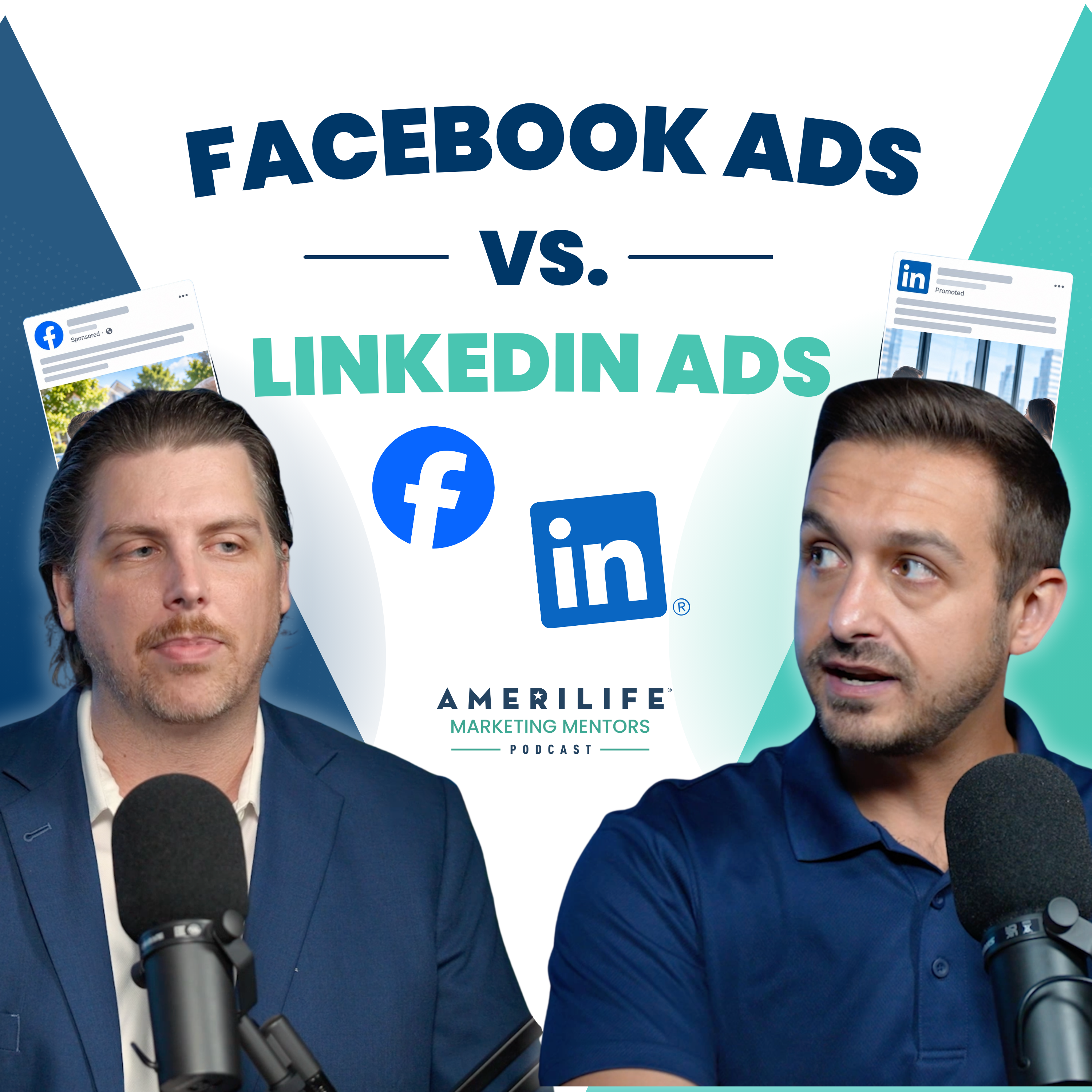
[00:00:01] Speaker A: Facebook and LinkedIn can both generate leads, but they don't work the same way. So if you've ever wondered where to spend your time, your budget, or maybe why your posts aren't turning into the conversations you need, then this episode is for you. I'm joined today by Ryan Eisenhower, the director of Growth marketing here at Amerilife, who's filling in for Jo Barker today. Ryan, thank you for being here. I cannot wait for the audience to hear your insights.
[00:00:26] Speaker B: Thank you for having me again.
[00:00:27] Speaker A: Yeah, absolutely. Welcome back, too.
So, to start off, Ryan, you are so involved in the growth campaigns that we produce for our affiliates and here at Amerilife, I mean, it's right there in your title, the growth marketing Director. So today we're talking about paid ads on Facebook and LinkedIn. So the first question I have for you today is when should an agent decide between the two and then what should be their driving decision to pick one of them?
[00:00:56] Speaker B: Yeah, this actually comes up a lot because the platforms are actually very similar in nature. So we're doing direct response marketing where people are getting hit with ads and they're not necessarily looking for something. But there's quite a few differences between the platforms. When you think about LinkedIn and Facebook, LinkedIn tends to be more expensive. So you have to really understand, like, what is the prospect that you're trying to reach and how are you utilizing that platform?
So as an example, with LinkedIn, you can actually search by occupations, you can search by companies that people work at. So if you have a very tailored audience that you're looking to get in front of you, you're probably better off on LinkedIn. Facebook historically has proved to be a better ROI platform, generally speaking, if you're just trying to reach a broader audience. But I would also consider, where are you spending your time organically? Are you more involved on LinkedIn or are you more involved on Facebook and that might end up guiding your direction?
[00:01:53] Speaker A: That's interesting. I want to follow up on that because what I'm hearing you say then is if I'm not active on LinkedIn, then considering a paid LinkedIn campaign might not be a great choice. So you're suggesting you need an active presence on whatever platform you want to pay for, right?
[00:02:11] Speaker B: Yeah. So it's not necessarily a requirement, but it's a good to have, because when people are starting to see these ads, it's attached to a profile. And some people are going to go look and explore who you are and try to understand if you're somebody that they can Trust.
If you're spending 80, 90% of your time building your business on LinkedIn. That's probably a good place to start. The beautiful part about this, David, is you can try a platform and you can run a campaign with minimal dollars and if it's not working for you, you can always switch to the other one.
[00:02:48] Speaker A: Yeah, absolutely. Testing is a humongous part of marketing.
To your point, you don't have to start out with a massive budget for every campaign you want to run. In fact, if it's an unproven something that you haven't done before, it's probably best to start out small and scale once the data tells you to.
So, Ryan, there's obviously different audiences on both of these platforms.
So what types of offers or content would you be producing for a paid ad campaign when it comes to Facebook and then LinkedIn?
[00:03:19] Speaker B: Yeah. So you always want to be thinking low friction. What is something that you can introduce that is not going to have a big ask for somebody, especially if you're reaching a cold audience. Now what I mean by that is you can certainly run different types of ad campaigns to your list or specific contacts that may already be familiar with you. But in most cases when people think of ad campaigns, they think of reaching net. New people that don't know about them, don't know about what they have to offer at that point. You don't want too much friction on the other side of things unless you're looking for very qualified leads. I think we'll get into that later. Talking about landing pages versus built in forms.
[00:03:58] Speaker A: Yeah, that's a great preview for that discussion.
Friction is the number one thing you really want to be paying attention to and making sure you're avoiding as much of it as possible.
What would you say is the difference between a campaign you might run on Facebook versus one you might run on LinkedIn? Is there one that's better for consumer facing campaigns or B2B campaigns or recruitment?
[00:04:22] Speaker B: Yeah. So I don't think you would necessarily have to pocket yourself into one type of campaign. I think universally both platforms work very similarly.
I would however, recommend always offering something of value. Sometimes people are going to be very product specific, which is great. Collect the information, reach out.
That is a great concept and opportunity to put out there into the marketplace. But what can you do that makes you stand out amongst your competition? How do you separate yourself from the pack? This could be something like a lead magnet, just a checklist, something very simple. It could even be more personal if you were willing to do video clips and things like that so they can get to know you and trust you.
[00:05:07] Speaker A: That's fantastic. That's actually a great lead in to my next question. Ryan, if you are going to be producing an ad campaign, what tactics or what should you keep in mind when you want to move that prospect through the journey that you've set out?
Let's say you have a lead magnet. What are the steps that you're hoping that prospect takes?
[00:05:31] Speaker B: Sure.
Very specific.
I think this is sometimes where people get a little overwhelmed with the process, where they say, okay, I'm going to make this or I'm going to have this offer. And they assume that the prospect is going to know the next step to make.
Oftentimes with social media, you want to have very specific directions, very clear, simple language that, great, you got this. Here's what's going to happen next, or here's how I can help you. Be very specific, Be simple with the directions, and you'll probably get a lot better response.
[00:06:06] Speaker A: Minimize friction, maximize clarity, and always ensure there's a next step.
Ryan, you work with a lot of agents, you work with a lot of Amerilife affiliates, and I would have to think that there's been some misconceptions you've heard when it comes to paid ad campaigns or mistakes that you often see. What's one big one that might come to mind?
[00:06:28] Speaker B: Yeah, I think oftentimes there is a misunderstanding of how much it costs to get started.
Either you had a bad experience in the past or you tried a campaign on your own and things just didn't work out the way you thought they should.
That is kind of the nature of marketing.
We're often having to go back and reevaluate and test. So the benefit of these platforms is in most cases, you can start with a smaller budget. You really can put something out there and let the marketplace tell you the feedback on that offer.
This is where it really does help to engage people that have the experience there. But you can start on your own as well. Again, there's just a lot of opportunity to just be able to get that direct feedback in real time, which is extremely valuable when it comes to your next decision.
[00:07:20] Speaker A: Yeah.
When an agent is deciding whether or not they should run a paid ad campaign, let's say they are very active on Facebook.
When should they make that consideration? What would prompt you to suggest you should consider a paid ad campaign, whether that be on Facebook or LinkedIn.
[00:07:39] Speaker B: Yeah. So there's like a good rule of thumb, and this is across multiple verticals and businesses, is test it on Organic. First, you're building an audience even if you're just starting from the very beginning. Put the post out there, see if you're getting engagement, see if you're getting the likes beyond your aunt and uncle and use that as validation that maybe this will work with a paid ad budget behind it. Now, you don't have to start there, but it's just a good way to test the waters and see what content resonates with people the most.
[00:08:10] Speaker A: Well, that also gives more credibility to the need to have an organic presence because how do you know if something's working well for your audience or resonating with your audience if you're not posting consistently and consistency is the word there, that doesn't mean you need to post every single day, every single week. It just means something that you can reliably stick with so that if a consumer comes across one of your ads and they decide to check out your profile, it appears that you're active, it appears that you're not dormant and it gives you credibility and reliability that can shine through again just by having a consistent presence.
So Ryan, let's say an ad campaign is getting clicks. It's getting the attention that you're hoping for, but it's not converting. You're seeing it break down somewhere along the way. How do you audit that effort? How do you identify what's not working? And what would you recommend for our audience if they're facing a similar problem?
[00:09:07] Speaker B: I'm so glad you asked this question because this happens all the time and it all comes down to the handoff. So just because you might make a great ad doesn't necessarily mean you're going to get the conversions you're looking for. It's really going to depend on the format.
Two of the most common ways, but it's not limited to, is to either send prospects to a landing page, which we'll talk about in a minute, or use the built in forms on these platforms. The reason why I want to point that out is if the ad resonates with them, but then they get to a landing page and it's just confusing. It doesn't match, they don't know what to do. You're not going to get a conversion and you're not going to get their information.
So you have to be looking at the full picture with all this. And the beauty of these ad platforms is you can set certain goals, KPIs or key performance indicators that you're looking for. Like maybe I want to get a click at $2 a click based on the outcome of a previous campaign. Once you set those goals, if you're not getting the conversions, you know what the problem is? It's not the ad, it's something else.
[00:10:11] Speaker A: Okay, so let's say we've identified that problem. I want to let our viewers know that Ryan Eisenhower is joining me for multiple episodes of the Amerilife Marketing Mentors podcast. And we have a whole episode talking about landing pages coming out next week.
But I do want to make sure we spend some time on them now, Ryan, because if that's the point of breakdown in an ad campaign, what are like the first few things an agent should look for if they're looking to optimize a landing page?
[00:10:41] Speaker B: Yeah. So you got to think about it like this.
There's points of friction, and it really starts with, is there a clear path of what do I do next?
Sometimes there is confusion about what a landing page is versus a regular website. To just keep this very brief, A landing page is very specific. It is a isolated page that usually has one objective and one offering. Websites will have multiple paths, multiple directions, which is not good for paid ads because that creates a lot of confusion and it can ultimately result in, again, people not converting. So you want to get hyper specific with everything you do, from your messaging to your offer and the flow of how you take people through the journey.
[00:11:27] Speaker A: Yeah, that's great advice, Ryan.
How should consumer facing campaigns differ from a recruitment campaign? Because in our industry, we know that we get approached to help clients with both.
How would you explain the difference between the two? If you're going to run one, sure.
[00:11:47] Speaker B: So with consumer, you're building a local presence and an identity.
You want to be the trusted person that they go through. Oftentimes it's going to be who they see first.
If you can do something that separates yourself from the rest of the marketplace, some type of identity, something that you own, that you are known for, that could come from the way you dress, the way you speak, the titles of your pages, or your websites. There's a lot of creative ways you can do that to stand out from the pack. I often think of Where's Waldo?
Anytime I would do that as a kid, it would be incredibly frustrating. But what did Waldo do that was different from everybody else? He stood out. It's the way he dressed. When you eventually found him, you were so excited. Be like Waldo when it comes to your marketing.
[00:12:40] Speaker A: I love that. It's funny that you mentioned Waldo. Two things that popped in my head immediately.
I hope the audience is familiar. But Conan o' Brien has branding of his orange hair, and that popped into my head for any of our followers who might follow Mel Robbins. She's got, like, her glasses are often a part of her identifiable traits. That's kind of what I'm hearing is find something that makes you identifiable and then really leverage that.
[00:13:07] Speaker B: Yeah, and actually I'm glad you mentioned that, because it could be a piece of clothing. You know, you think of people like Steve Jobs like there's something that is consistent. And when people see consistency, their guards drop. They become more comfortable. They actually become more trusting. If you can turn that into a digital presence and you're doing that online, organic or through ads, you're going to be in a much better spot.
[00:13:34] Speaker A: I couldn't agree more. And trust is always the through line in anything that we talk about here at the Amerilife Marketing Mentors. If you're going to put budget behind something, then you really should have faith that your audience is going to respond to it. Which means that you have faith that your audience trusts you. And that's where an organic presence can really help lift your paid ad campaigns, because you're always building trust through organic. And then when it's time to pay for attention, you're just giving yourself a leg up. Ryan, as we wrap up this conversation today, what is one big takeaway? That if our audience leaves with anything, you would want it to be this.
[00:14:14] Speaker B: Ooh, that's a tough one.
[00:14:15] Speaker A: Put you on the spot.
[00:14:16] Speaker B: Yeah. So I do think in this world where we are constantly bombarded with distractions and attention span is probably the shortest it's ever been, it's all about speed. Speed to lead. We all know what that means. But when it comes to organic ads, whatever it is, make sure you have systems in place, whether it be through automated messaging, like emails, or anything of that nature, that's going to help you get in front of that contact as quickly as possible.
Otherwise you're going to run into more issues where you might have had a good lead, but they've already moved on to something else. I would focus on that. That would be the big takeaway. I'd advise.
[00:14:57] Speaker A: That's a great final takeaway. Ryan, thank you so, so much for joining the Amerilife Marketing Mentors today. And thank you for joining us on another episode of our podcast. If you found this conversation helpful, please be sure to subscribe to the Amerilife marketing mentors on YouTube or we wherever you get your podcasts. For Ryan Eisenhower, thank you again for joining us today.
[00:15:18] Speaker B: Thank you.
[00:15:19] Speaker A: I'm David Belleville. Thanks for hanging out and we'll catch you later.