Episode Transcript
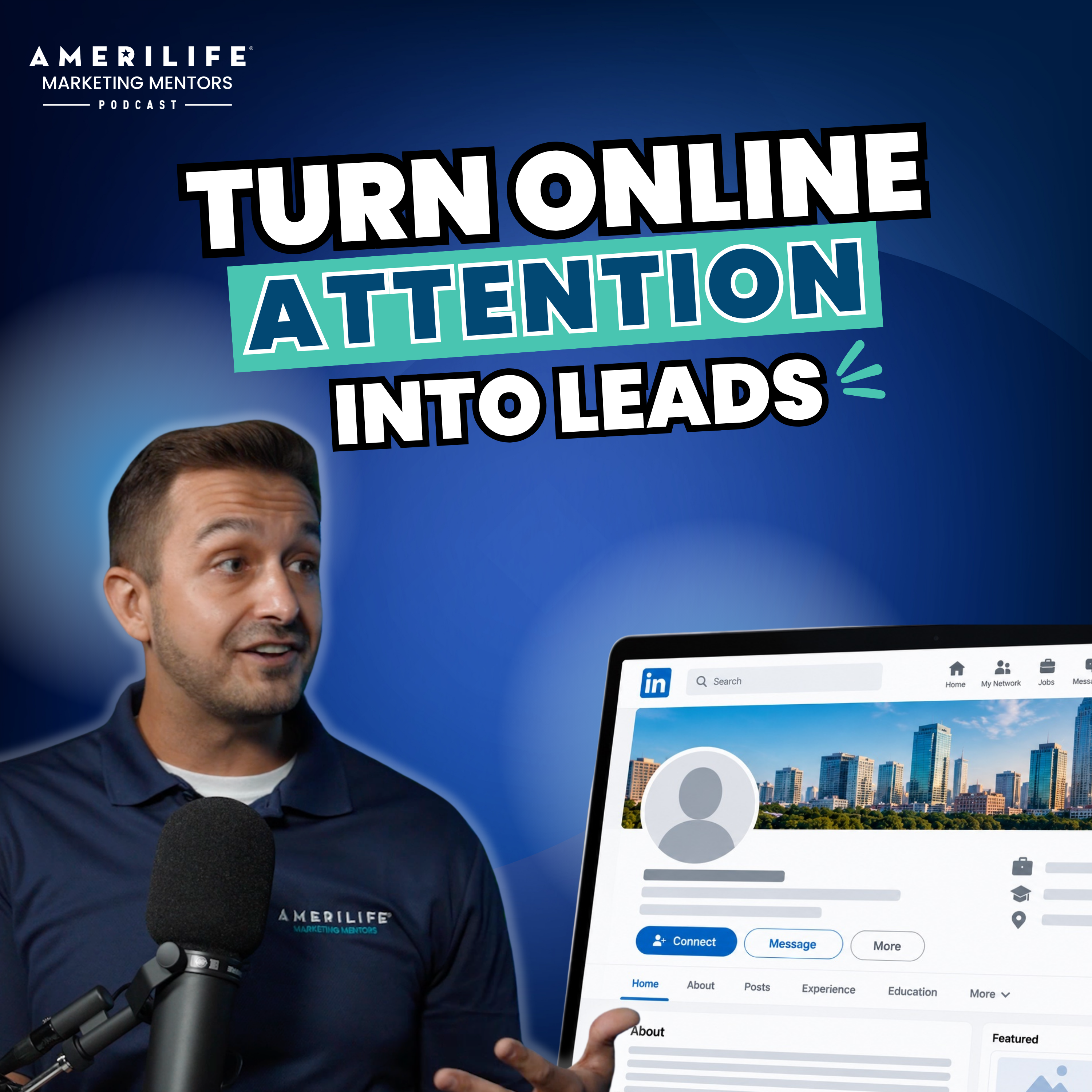
[00:00:00] Speaker A: Insurance agents and financial advisors often put a ton of effort into their marketing, and yet we still hear all the time the same questions. Of course, one of the most critical questions we get is where are my leads? So Today we're covering LinkedIn AI and how to increase the chances of you generating leads with your marketing. Now let's bring in Ryan Eisenhower, the Director of Growth marketing here at AmerLife, filling in for Jo Barker today. Ryan, thank you so much for chatting with us today.
[00:00:28] Speaker B: Thank you so much for having me.
[00:00:29] Speaker A: Of course. And three of the biggest topics that we tend to hear about the most are what I just listed. It's. It's LinkedIn and how to leverage the most out of that platform AI.
Should I be using it? What for how much? I mean, we cover the gamut with AI, of course, and then, and then there's lead generation, which of course, when it comes to marketing in the health and wealth space, is the ultimate goal most of the time. So, like, start out with LinkedIn first and foremost.
Why should agents and advisors consider being on the platform?
[00:01:01] Speaker B: Yeah, so LinkedIn has really come a long way over the past few years. I think it went through a period of time where there was a lot less people engaging on it. But LinkedIn is back and it has a little style to it. Now, traditionally, when we think about LinkedIn, we think, oh, it's just kind of standard where people are congratulating each other on promotions and things like that. That's probably the cliche version of LinkedIn, but there's so much more to that platform, especially today.
One of the things to think about is just because you're on LinkedIn does not mean you need to depersonalize your content. And I think that's something we can talk about today.
[00:01:40] Speaker A: Yeah, let's get into it then, because you're right. I think that the stereotype of LinkedIn is that it's a buttoned up platform where you put on your corporate speak, you hop into the comments, you say, congratulations. Or the flip side of that is that it's a job board and you only use it when you're looking for a job or you're hiring for a role. But there's a nice place right in between all of that, where, to your point, you can showcase your personality, your business and your expertise.
When it comes to LinkedIn, there are few platforms that give you that credibility built right in.
[00:02:19] Speaker B: Yeah. And LinkedIn's kind of going through some challenges right now because we are seeing this divide between content that is deemed to be AI. Generated and content that is real and organic. You don't want to get caught in the middle of that. Even if you can very easily generate an AI post, which can be helpful if it doesn't have personality to it, or it doesn't have an image or something that feels organic and feels real, it's going to get lost in the shuffle and it could even get marked down.
[00:02:50] Speaker A: Yeah. LinkedIn is putting so much resources, so many resources, I should say, behind making sure that the content that is on the platform is relevant. It's got a human touch and you're seeing things like the AI slot button, for example, if you're unfamiliar with that. It's a new feature that LinkedIn rolled out this year so users can stamp out what they believe to be AI slop. So just to your point, LinkedIn is trying to figure out how to keep their feed relevant to the users and making sure that, again, AI slop is not taking over.
I think that this might be a good lead into this question, Ryan, is what are some of the biggest mistakes that agents do make on LinkedIn, if they're on there at all.
[00:03:34] Speaker B: Yeah. So this is a good reminder that what you put out on the Internet tends to stick around. And we'll see with LinkedIn, like any social platform, what you comment on, what you post, it's visible pretty much to everybody. So you want to make sure that what you're putting out there is aligned with how you want to be perceived.
Again, it doesn't have to be overly professional, even though you want to keep some standards there. Your personal life, in terms of showing, you know, local events that you've gone to, things that help build trust and rapport with people, is a great addition to the, to the educational content that people might typically stick with.
[00:04:16] Speaker A: And because there is so much similar looking and feeling content on the feed, being the one that steps out of the comfort zone of LinkedIn is could have a big payoff because you stand out then on the feedback from everybody else who you know is posting and sharing the same similar stuff. And if it's AI generated, it very much all could sound the same.
I want to stick on this point here, Ryan, because I think that people are hesitant to post on LinkedIn.
A vast majority of users on LinkedIn are just passive scrollers and consumers rather than creators. And I wonder why you think there is that hesitancy to post more often on LinkedIn.
[00:05:02] Speaker B: Yeah, so I think when we think about LinkedIn versus something like Facebook, Facebook typically has people that might be in our closer Sphere of influence, friends, family, things like that. And there can be a blurred line between LinkedIn and Facebook where you also have friends and family. But I think for a lot of people, they pursue that. They have to be more rigid with their content and more stoic in terms of how they communicate and they approach things. And I'm finding, especially with the content I engage on LinkedIn, it's quite the opposite, very personable.
[00:05:43] Speaker A: I couldn't agree more. The content that I see performing well the most is the ones with personality behind it, because that is what AI lacks and can't provide is your personality and the perspective that you share. Which is another thing that I encourage our audience to do is get on the platform and share your perspective, your takes on the industry. We're not asking you to start controversy, but we are asking that you do put a little bit of yourself into your posts because that is what will help you stand out on the platform. And Ryan, if you want to use the platform for real business opportunities and to generate attention and leads for your business, where would you start instead of just focusing on views on your content or the number of connections you have?
[00:06:29] Speaker B: Yeah, you have to also get off your own page, so you want to actively create. But LinkedIn is definitely a platform where engagement matters probably more than any other platform I've seen where when people comment again, the visibility is spread out there. You can really build your network large and fast, you using something like LinkedIn. So just make sure you're proactive with that.
Don't look at it as an afterthought. Make sure it is a primary goal when you get on that platform. Go engage, get yourself in the conversations.
[00:07:03] Speaker A: I couldn't agree more. Comments are probably one of the biggest signals to the algorithm to keep distributing that content.
Let's get into AI. Now, obviously AI has dominated pretty much every tech technology based conversation for the last three years or so and there's no reason to stop now because there is still so much uncertainty out there around AI. And for those who haven't started using it for their market marketing yet, which there are many out there, they feel like they may be behind, they're overwhelmed and they don't know where to start.
So with so many tools available now, Ryan, where do you think insurance agents who might be over complicating things should start and what are some useful ways that they can start getting comfortable?
[00:07:49] Speaker B: Yeah. So if you're just starting with AI, we have to get realistic about are you completely brand new to it or you likely probably using many of the tools that are starting to be built into our phones, built into many of the platforms that we already use.
Very likely you're probably somewhere at the beginning where you are already engaged with AI in some shape or form, but you're not exactly sure how AI is going to work for you. You.
This is where it comes back to. All of these AI models are based off of input information.
So when you're engaging with an AI, you want to make sure that you're feeding it the information that is relevant to your business, information that can make it serve you as an assistant and help your productivity versus hindering it.
[00:08:38] Speaker A: Yeah, I. This. I don't know how this is going to land, but I. When I think that you can compare AI to a potato.
Let me elaborate. If you have a potato, it's a potato, it's edible and it's fine. But the more you work with this potato, you can fry it, you can mash it, and there's waffle fry versions. I mean, there's a good one. The point I'm trying to make is the more you use AI, the more use cases that you can find from it. And there's a lot of use cases for a potato. I don't know if there's anything to that. I don't know if I should write the book yet or not.
[00:09:11] Speaker B: No, that's. You should probably write the book on that because it is true. And, you know, it's almost like you're trying to jump on a train and the train is going very fast. You know it's going somewhere.
There may be some uncertainty in the final destination, but you know that it's something that you probably want to be on. Right. If you want to have direction. And so the hard, the hard reality of AI guys is you want to use it.
You don't have to be the expert at it because nobody's the expert at AI. AI is advancing so fast, and you're always going to be a student, you're always going to be learning. So find the AI tools that work for you, and you're going to be a much better spot.
[00:09:55] Speaker A: I'm glad you said that, because we're students, we're still learning every day about how to get better with AI.
The point I was trying to make is that the more you use it, the more you realize how much more you could be using it and so many other use cases. So just get started today with little things that don't matter too much to the success of your business and allow that to help you get comfortable let's flip this conversation around now. What are signs that people are relying too heavily on AI?
[00:10:26] Speaker B: Oh, yeah. So this is a big one. So we've all seen these trends, right, where something happens and everybody jumps on board. And that's great when it comes to social posts and just having a good time. But. But when it comes to business, I've started to notice that people are sometimes leaning heavily into AI for graphics. You've probably picked up on this. There's a certain style, and you just know it's AI generated and it's not necessarily a bad thing versus having nothing at all. But it starts to get muddying the waters where everything looks the same. And in a world where you need to stand out and you need to be above and beyond, look for those trends, try to find ways to separate yourself. And this is actually going back to AI itself.
If it looks a certain way, prompt it, Try to make it look a little bit different so it doesn't copy the same style as everybody else.
[00:11:22] Speaker A: Yeah, that's great advice.
So when it comes to LinkedIn and when it comes to AI, and really any tool or platform that an insurance agent or financial advisor might be using, the goals are usually the same, and that's to drive real business outcomes, to grow your business, to drive in leads. And so if they're getting the attention that they're looking for, but that's not converting, what do you think that disconnect could be and how do they address it?
[00:11:50] Speaker B: Yeah. So this is again where I would take AI and I would leverage it as an evaluation tool. Right. So feed it the information and let it act as a consultant for you.
I can't tell you how many times I've tried to figure something out. I popped it into AI and I was like, I should have thought of that.
You will have those experiences the more that you engage with AI and the more information you give it about your business, your prospects, and basically your mission.
[00:12:21] Speaker A: So now we've talked about LinkedIn, we've talked about AI, and truly, whatever tool or platform an insurance agent or financial advisor is using, the goals are often the same. They're looking to drive real business outcomes, and they're looking to drive in leads. So, Ryan, if an agent is getting attention online, but they're not getting any of those real business outcomes, what do you look for first? And what would you advise our audience to look for first?
[00:12:48] Speaker B: Yeah, so this is a great opportunity for you to take the material you're putting out there and actually put it into AI to get that Feedback. I think the first time I used AI to analyze images and screenshots, I was just blown away the fact that it could read it and actually give me real valuable feedback on it. So I would start there.
[00:13:10] Speaker A: Yeah, that's fantastic. What do you think insurance agents often miss when building awareness and trying to get someone close enough to become a lead?
[00:13:21] Speaker B: Yeah. So I think sometimes there is a disconnect from the real world versus the digital world. They don't always equally translate. So you may be a phenomenal person. Face to face seminars, just door to door outreach, however you do it.
But when you're trying to take that same style and put it into a digital world, it may not translate. We often see this times where people will take mailers that they send out and they will try to turn those same mailers into digital ads. The problem is a mailer traditionally has a lot of information on it, which doesn't work for a digital ad where people are scrolling very fast. So you got to think about how are you going to present yourself online versus how you present yourself face to face in the real world?
[00:14:12] Speaker A: Yeah. And then you need to do that consistently enough to gain credibility, familiarity, and build trust with your audience, because that's the easiest way to convert a lead is when you've built a relationship on trust and they trust you enough to make or help them make those really tough decisions. So consistency is key, no matter what platform you're using, whether that be social media, email marketing, keeping your website updated, webinars, seminars, I mean, the list could go on. Consistency is often key, and that's how you build awareness and keep driving attention to you and your business.
Ryan, if an insurance agent told you I'm marketing consistently but I'm not seeing any new leads come in, what's the first piece of advice that you would give them?
[00:15:00] Speaker B: Well, I would first ask them, what is your offer?
What are you putting out there that would get someone to give up their information and then try to place yourself into their shoes?
We often will separate the ads and the marketing that we respond to, but we'll do something completely different when we go to create it ourselves.
We are human beings, we have very similar behaviors and patterns, and often what you like might be what somebody else's likes and vice versa. So when you're going through your funnel, when you're going through your marketing, ask yourself, is this compelling? Is this something that would get me to give up my information and then that will help translate to maybe I need to make an adjustment or a modification?
[00:15:45] Speaker A: Yeah, that's great first advice. And I actually have one more question. I want to end on here, Ryan, because there can be people out there that are, you know, doing the most. They're all over social media and they, and they really are putting their time and effort behind it. But if you don't have a system set up to measure that success, and we're not just talking about likes and comments and shares on the platform, we're talking about real business outcomes that can move the needle for, for you and your business.
A lot of people can mistake busyness and activity for success in marketing. So before we, we, we end this conversation today, Ryan, what metrics should our audience be looking for that signals that they are getting closer to driving leads?
[00:16:34] Speaker B: Yeah. So depending on how you are engaging the lead after they come through, it could be through a booked call like a calendar platform or you're calling them. I would be hyper focused on are you getting responsive leads? Because that's ultimately what you want.
A name and an email is great and you can technically follow up forever, but what you really want is conversations. So I would hyper focus on that and use that as a means to look back and see if it makes sense.
[00:17:04] Speaker A: I love it. The journey and your efforts do not stop after you click post. There is so much more on the back end that can lead to your success and who knows, maybe lead to your next client. But Ryan, thank you so much for tackling some of these most important issues for our audience today. It's always awesome to have you join the Amerilife Marketing Mentors podcast. Thank you again for joining us.
[00:17:28] Speaker B: Thank you so much, David.
[00:17:29] Speaker A: Yeah, absolutely. And again, that's Ryan. I'm David. If any of this resonated with you, we encourage you to subscribe to the Amerilife Marketing mentors here on YouTube or wherever you get your podcasts. Thanks for hanging out with us today and we'll catch you later.