Episode Transcript
[00:00:00] Speaker A: When should I be sending an email and how often? I think that those are two big questions.
[00:00:05] Speaker B: If you're sending a commercial sales message and you're irritating your clients, they're leaving because you didn't deliver to help them. You delivered to help yourself.
[00:00:14] Speaker A: We've talked about how important open rates are because that is the gateway into your messaging. If they open that door, then you've moved them one step closer.
[00:00:22] Speaker B: You've done all that work to get that information, that email, that's that opportunity. Collect that data, but then make sure once you have it, you use it.
Hey.
[00:00:31] Speaker A: Hey, everybody. Welcome back to the Amerilife Marketing Mentors podcast. My name is David Belleville.
[00:00:36] Speaker B: And I'm Jo Barker.
[00:00:37] Speaker A: And today we are talking about email marketing. What emails you should be sending, how and when should you be sending them, and what success looks like. And we are just about a month away from aep, so it's another great time to be auditing your email process and setting yourself up for success. So, Jo, let's first set the stage for this conversation. Why is email marketing so important to one's marketing strategy?
[00:01:03] Speaker B: Well, you do all that work in order to, to gain that relationship. So in the beginning, a lot of it's about getting that lead. So you've done all that work to get that information, that email, of the potential client. Now's the time to put it to work. And of those that are already your clients, it's a great way to stay in touch with them without being intrusive as a phone call or a text. It's as long as you're providing value, it's that great opportunity to share knowledge with them, share value with them, and it's not intrusive when you're, maybe you're
[00:01:32] Speaker A: just starting out, maybe you're a newly licensed agent. Where do begin when you want to start building an email list?
[00:01:38] Speaker B: Well, you have to provide something of value. So if you have a client list, obviously that's going to be the first thing for you. But typically what you do is you put information out there. So say it's the top 10 things that you need, that the top 10 things you didn't know about Medicare, whatever it is, you put out a piece out there and it's called gating it to where in order for people to download it, they provide their information. So how we've always looked at it is provide value. Certain information you may want to gate, and that's where you collect their information from. Webinars are great opportunities because you're asking them to spend a little bit of time with you and at the same time you're getting their contact information in return. And all of that just starts that journey with everybody's attention so scattered now. I mean it's across the board where people are spending their time. You want to put as much information out there and if you get to a point where they want to subscribe to your newsletter or they want to connect with you because there's a piece of value ad that you put out there that they would like to, that's that opportunity, collect that data. But then make sure once you have it, you use it. Otherwise if you just, you know, try one time to get the, for the sale and then you toss it aside, that's all just wasted roi. I mean that's all that follow through you missed.
Just because they didn't sell immediately, which most of them won't, most of them are researching.
[00:02:54] Speaker A: You mentioned how scattered attention is these days. So I kind of want to draw a comparison to each. Social media marketing when we're talking about email marketing and the reason is because social media tends to, you know, be flashy. It's, it's so visible and the success metrics just come a lot quicker and so social media can kind of steal the spotlight. But when you're talking about a social media following, how is that different than an owned list of contacts?
[00:03:24] Speaker B: Well, the social media following, you know, you're working for that and you're, you're hitting them where they're spending their time. That is, you know, people are there for entertainment, they're there for news news, they're there to learn anything. The algorithms now, anything that they're spending time on, they're going to get more posts like that. So that you want to make sure anybody that's researching Medicare, they're going to automatically start to see those feeds come in there. But when you move over to email marketing, when somebody gives you their, their email, they're trusting you with that and they don't want to be spammed. And that's kind of how you have to treat that is on social media you can put things out there knowing that one, not everybody's going to see it. And then of the ones who want to see it, if it's important to them or if it, you know, if it's a value to them, they'll engage or they'll spend some time reading. When it comes over to email marketing again, you've done all that work, you've gotten them to provide you that email so you Might as well use it and try to get them to that next step in that journey. And a lot of the times it's not even the next step of the journey. For a lot of the times it's your clients. And you're protecting that relationship. You're making sure that you're following through on all the great work that you did for them last year and making sure that you're make they know you're here again this year for any questions they may have.
[00:04:29] Speaker A: And we talk about controlling the controllables. And when you're at the mercy of a social media algorithm, you know that that's relinquishing some of the control over your message. But email marketing, I mean, you have a direct line of contact straight into somebody's inbox. So, you know, there are so many great benefits to email marketing, but those benefits only come through if people are opening your emails. So, Jo, what are some strategies and things to keep in mind to increase those open rates?
[00:04:59] Speaker B: Well, the subject line is vital and it's vital for more reasons than it ever has been before. Because that subject line, especially with the AI now controlling the inbox, it's going to determine where you're showing up in that inbox. So it could be under a promotional feed, it could be, you know, not in the top priority feed. So those keywords that you utilize in that subject line are going to make a big difference on where you show up. But the subject line is what tells the person this is what this email is about. So you want to make sure that that line grabs their attention and that it speaks to them and it's important to them. So you don't want to just put generic information in there. But, and what's great is if you have a relationship within there with them, put their name in that subject line and say, hey, hey, David, it's been a while. Just want to touch or just want to touch base and see how you've been doing or something along those lines. That way you see it and you're like, oh, okay, I remember this person. Let me go in and go check that email.
[00:05:51] Speaker A: And especially if you've worked with them before, that is such a great opportunity. That would mean so much more to me as a consumer than, you know, an email from somebody I've never heard of or talked to.
[00:06:03] Speaker B: Personal touch means a lot. And so what's important though, is when you create those emails, it doesn't always have to be flashy, doesn't have to be the heavy graphic. If it's me, just Reaching out to say, hey, hope all's been well. Just want to check in and see if you need anything. I'm going to write just that and I'm going to say, hey, David, it was great working with you last year. As we're getting close into, you know, this year, it's been a while since we've had a conversation. Just want to ask, do you have any questions? Yeah, Anything I can help you with? Don't be a stranger.
[00:06:29] Speaker A: When should I be sending an email and how often? I think that those are two big questions that agents and advisors would have if they're either just starting out with social or, excuse me, email marketing or they're looking to improve their email marketing. So do you have anything to add to that?
[00:06:47] Speaker B: So you definitely want to come up with one a cadence to where you don't go too long, but you need to let the data tell you what's resonating and what's not. So the most important thing is don't just send the messages to sale. Don't all, don't always just be about the sale or just be about what it is you want to get out of the relationship. Make sure you're catering to who you're sending it to, provide value and give as much away as you can. Just be as valuable as you can to your, to your clients and to your potential clients to where they realize I'm not asking you for anything in return. I'm just trying to tell you what other people are asking or what I'm noticing in the market right now that I think you need to be made aware of.
[00:07:24] Speaker A: Yeah.
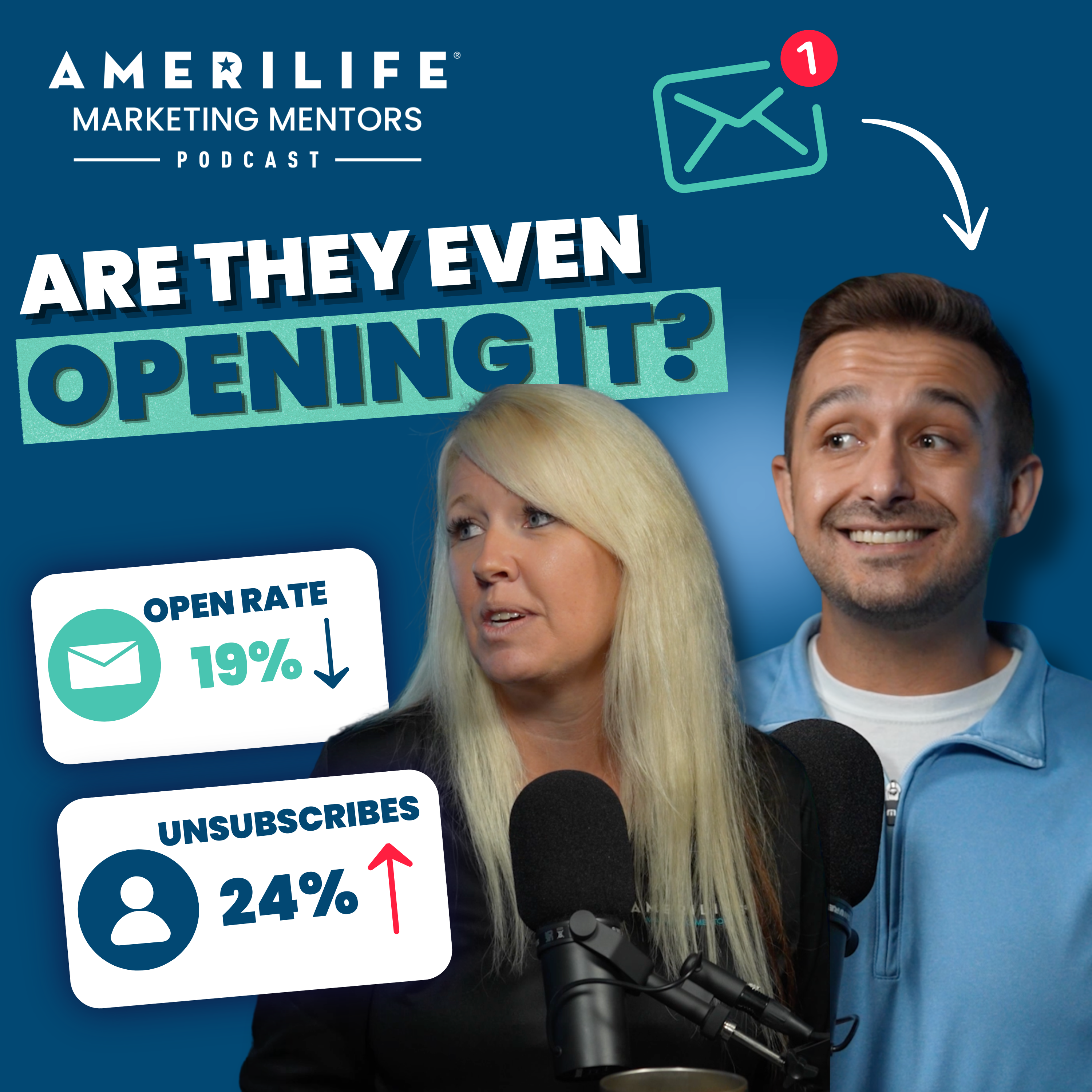
[00:07:25] Speaker B: And when that happens, it doesn't feel like a sale and it doesn't feel like, oh, this person's trying to sell me again. It's more of oh, wow, I didn't know that. Thanks for telling me. And you'll your open rate, your click through rate, all those type of key data points that you should be measuring. That's what you want to pay attention to and you're going to know about your unsubscribes if you're missing the mark. So if you see those unsubscribes really start to skyrocket, look at that email and find out why. If you're sending a commercial sales message and you're irritating your clients, they're leaving because you didn't deliver to help them, you delivered to help yourself.
[00:07:59] Speaker A: Yeah, great points.
You mentioned click rates, we mentioned open rates and then there's click through rates as well. And there's also Tons of other metrics that we could get into, but those are three of the big ones. And we've talked about how important open rates are because that is the gateway into your messaging. If they open that door, then you've moved them one step closer to hopefully a call to action that's living inside that email. But once they've opened that email, Jo, how are we to get a prospect to engage with that email and keep them interested?
[00:08:32] Speaker B: Well, it's really looking at it and seeing what is the purpose of the email, what are you trying to accomplish? So before you even get ready to send the emails, make sure you have an idea of what your goals are. We know you're never going to get 100% open rate. You know, if it's a message that they're not expecting, we know that. And so you really have to set expectations. So Maybe it's a 15 to 20% open rate that you're shooting for. And of that, if the subject line is proving that it can, that it's delivering a 20% open rate, then make sure that your messaging matches what you said in the subject line and then look and see what are they actually clicking on. Sometimes it's okay if it's not the call to action. So I'll give you an example. We did an email campaign and we noticed that there was a high click through rate. But when we looked at it, it wasn't to the landing page that we were sending them to. We realized it was to social media. They were going all the way down to the bottom and the biggest clicks were going over to our Facebook. So then it told us, okay, they're clicking on this, they're curious and they want to learn more, they're not ready to commit to the CTA yet. That is great learning. So even though you could look at it and you could say, oh well, the CTA failed, maybe you could, you could say that. But really what it's telling us is they needed more information before they were ready to commit. That is all learning and that's all great for us to know. So what do we do? We go click where they clicked, where did we send them and what experience did we send them to? And does it make sense for what you know, for what it is they were probably trying to research. And so that's a great opportunity to make sure your social medias are upgraded or are up to date. It's also a great opportunity to where if you have a video on Facebook that talks about that subject, go ahead and link that Facebook over to that video, let them go see that video to learn more about it. But it's great learning. So then the next time you can send them an email to everybody who opened but didn't complete, hey, here's a couple of additional information pieces to tell you more about that.
Now give them the CTA again. And so it's all learning and it's all making sure that you're, you're reacting to the actual responses and to the actual data.
[00:10:29] Speaker A: And when we talk about making decisions to optimize campaigns, when should those, let me ask this differently. When does a pattern emerge?
So how many sends should I be sending before I decide this is a good sample size, I'm ready to make a decision based off of it.
[00:10:48] Speaker B: So I watch 48 hours after every email send, I take, I at least take a pulse to understand what happened. You want to have those benchmarks going into it and then really want to make sure. And you want to wait 48 hours because not everybody's checking their email as soon as it's sent over there. So you want to make sure that you're waiting and take a look. One email doesn't make a trend, but as you start to notice those open rates, as you start to notice those click through rates, that's what you want to pay attention to.
I used to tell everybody I would treat email marketing like a video game and whatever my scores were for that first email, that next email, I wanted to beat those high scores and I wanted to try to get to the next one. And the only way to do that is to know the data though. And, and you really have to stop and take a step back and walk through the entire process as the consumer to understand, you know, to really look at it from their perspective. When we're creating content, when we're creating emails, I think we, we tend to get tunneled, visioned and we tend to just have a purpose and we go really, really strong towards that purpose. And then when we come back and we review it all as the consumer, we realize like, oh, wow, we might have actually hit the mark here. We kind of, you know, our messaging wasn't 100% or it wasn't quite of the value that we wanted. It was probably too salesy. We said what we wanted to say, but not what they wanted to hear. Those are the type of things you have to go back and just reexamine it. You don't need to spend a lot of time. The numbers are pretty obvious when you're looking at them. You can see open Rate how many people scanned it, how many people clicked on something when they went to your landing page. If you had a high click through rate and they went to the landing page and didn't convert, you have a problem. You need to go back and look at that process. What did I miss? I got them to open, I got them to click, I got them to go here, but then they stopped. What caused that? And those are the type of things where you just have to take your time and be curious. Don't go into it thinking you know it all. You have to be curious.
[00:12:34] Speaker A: Let's end on AI. Where does AI fit into all of this?
[00:12:39] Speaker B: I think it's across the board. It can help you with your segmentation of your list. As long as you don't put any proprietary data into your AI list. You can tell it the types of the types of data that you have though. You can say, I have a lead list, I have a current client list, I have a unengaged list where they haven't engaged with me in over a year. You can put that information in there and ask AI to act as your email content specialist to help you create journeys and touch points and then ask IT to help you create those benchmarks and have IT research those best practices for each of those. How often should I be sending these emails? If this is an unengaged list, at what point do I remove them from the list? Because they're not engaged anymore and that's the type of information. So there's endless use cases that I could find. And the one thing we always say though is just don't copy paste. AI is great. It's getting better and better, especially the more you train it at sounding like you. But you don't ever want to just copy and paste. You want to make sure that you're reading that email, make sure it sounds like you, and be natural. People want human interaction more than ever, especially with AI doing so much of the content writing. So make sure it sounds like you and it's something that you would actually write.
[00:13:48] Speaker A: I love it. Jo, thank you so much for the insight. If you need a little extra help leveraging AI for your email marketing, the Amerilife Marketing Mentors just published an AI prompt library, so we'll link to that right down below. But there are AI prompts that you can start using today to start improving your email marketing strategy for tomorrow. But in the meantime, if you're not subscribed to the AmerLife Marketing Mentors, please do that right now. Jo, thank you for your insights today for Jo. I'm David, and we'll see you next time. Time.